
Bulgaria’s BESS Market Is Moving From Growth to Execution
 Next element
 Introduction
Bulgaria’s battery energy storage market is becoming an active, fast-moving market where asset owners, developers, and traders are already testing what commercial performance looks like in practice.
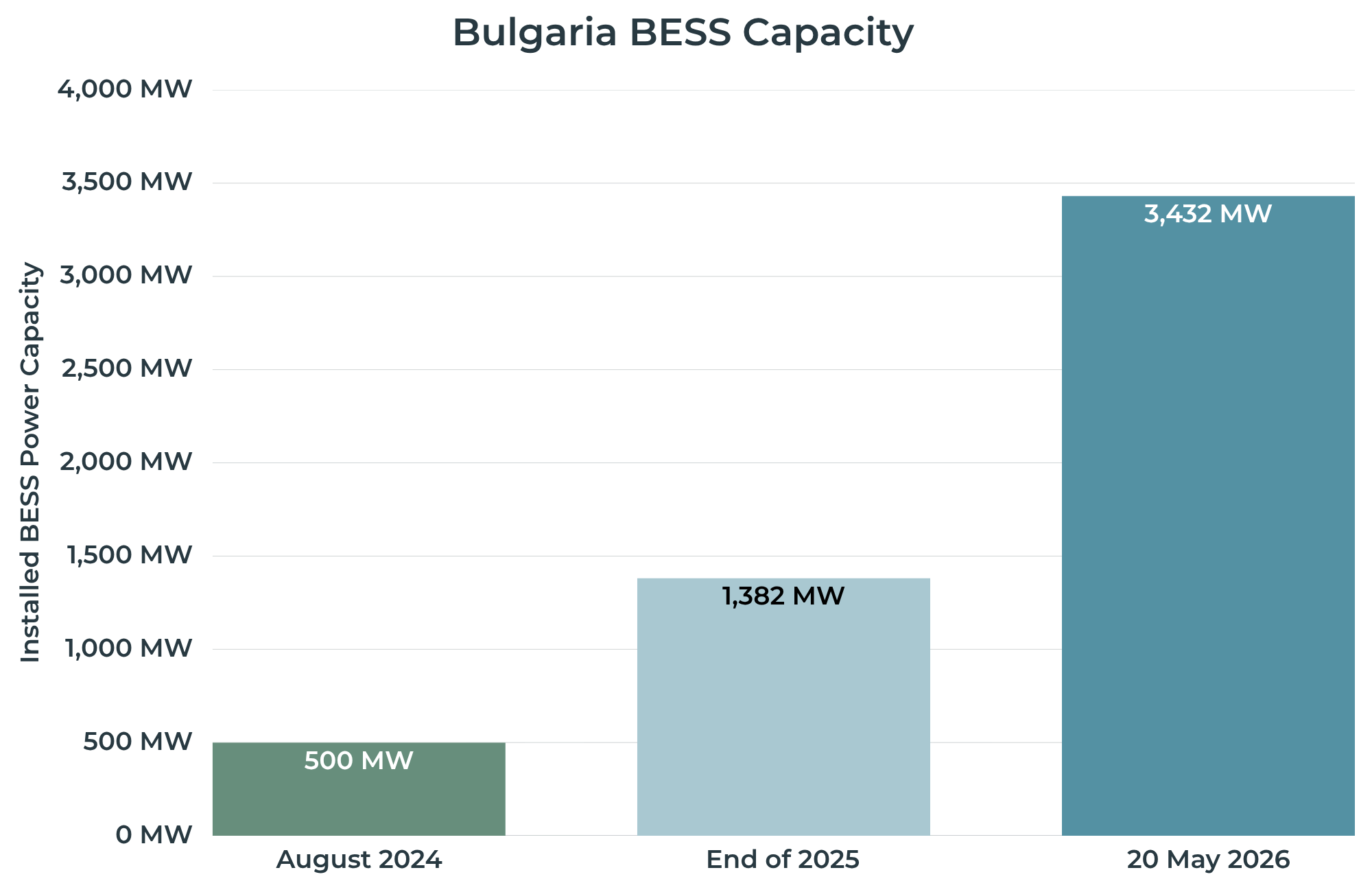
Solar growth is changing the country’s daily power price profile. RESTORE funding is accelerating grid-scale storage deployment. The European Commission states that the RESTORE investment is financed with EUR 603 million from the Recovery and Resilience Facility and is designed to support renewable integration, system security, and the readiness of the Bulgarian electricity system. This gives Bulgaria one of the most active state-backed storage pipelines in Europe. The broader market has grown well past that state-backed base: ESO reported 3,432 MW of installed BESS capacity as of 20 May 2026, and independent tracking by Capital, a Bulgarian business publication, put the figure at 4,823 MW by June 2026 based on its own project-by-project count, ahead of ESO’s official reporting.
More batteries are entering the system, and asset owners are now asking the question that matters most: how will these assets perform as the market becomes more competitive?
The answer will not come from installed capacity alone. It will come from market access, technical integration, transparent operation, and the ability to optimize across Day-Ahead, Intraday, and balancing opportunities as they develop.
Understanding the Bulgaria BESS Market
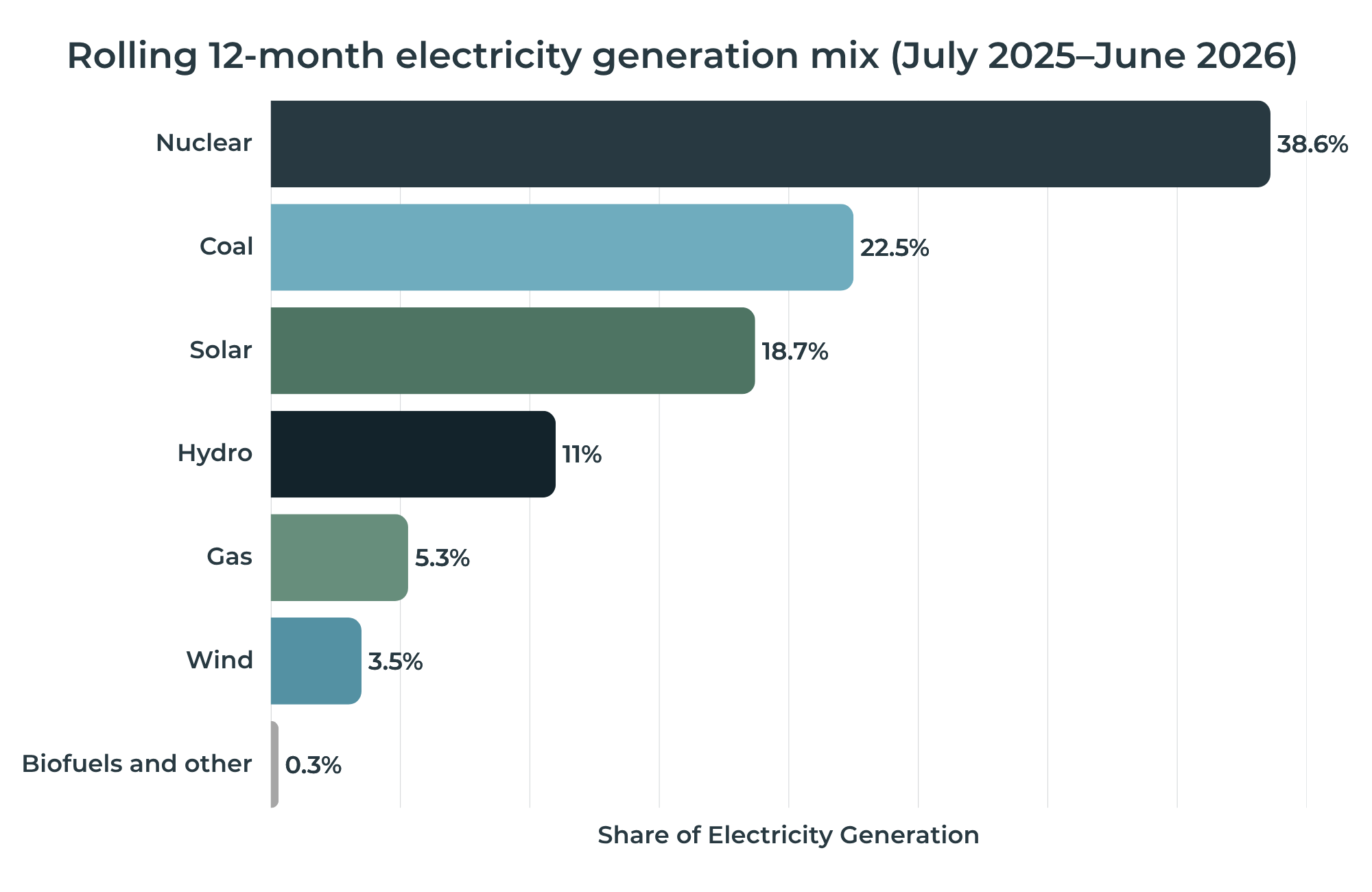
Bulgaria is built around large baseload generation, with nuclear from Kozloduy and coal from the Maritsa basin remaining central to the system. But solar has become a material part of the generation mix and is now reshaping price behavior during daylight hours.
The fastest-moving part of the market is solar. Bulgaria added 1,350 MW of new solar capacity in 2025, the third consecutive year with more than 1 GW of annual additions, taking cumulative installed solar PV capacity to 5,910 MW by the end of the year, per IRENA.
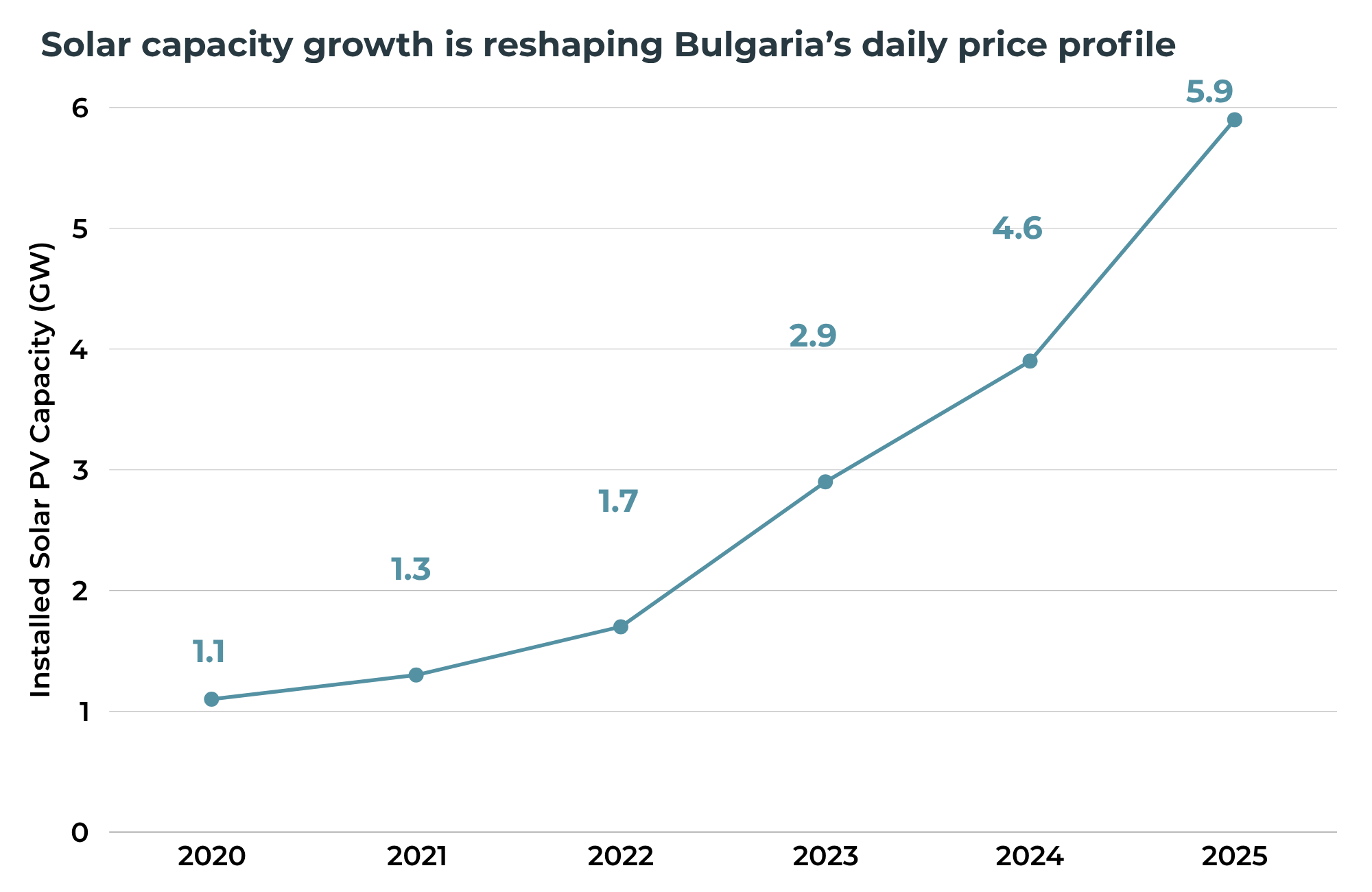
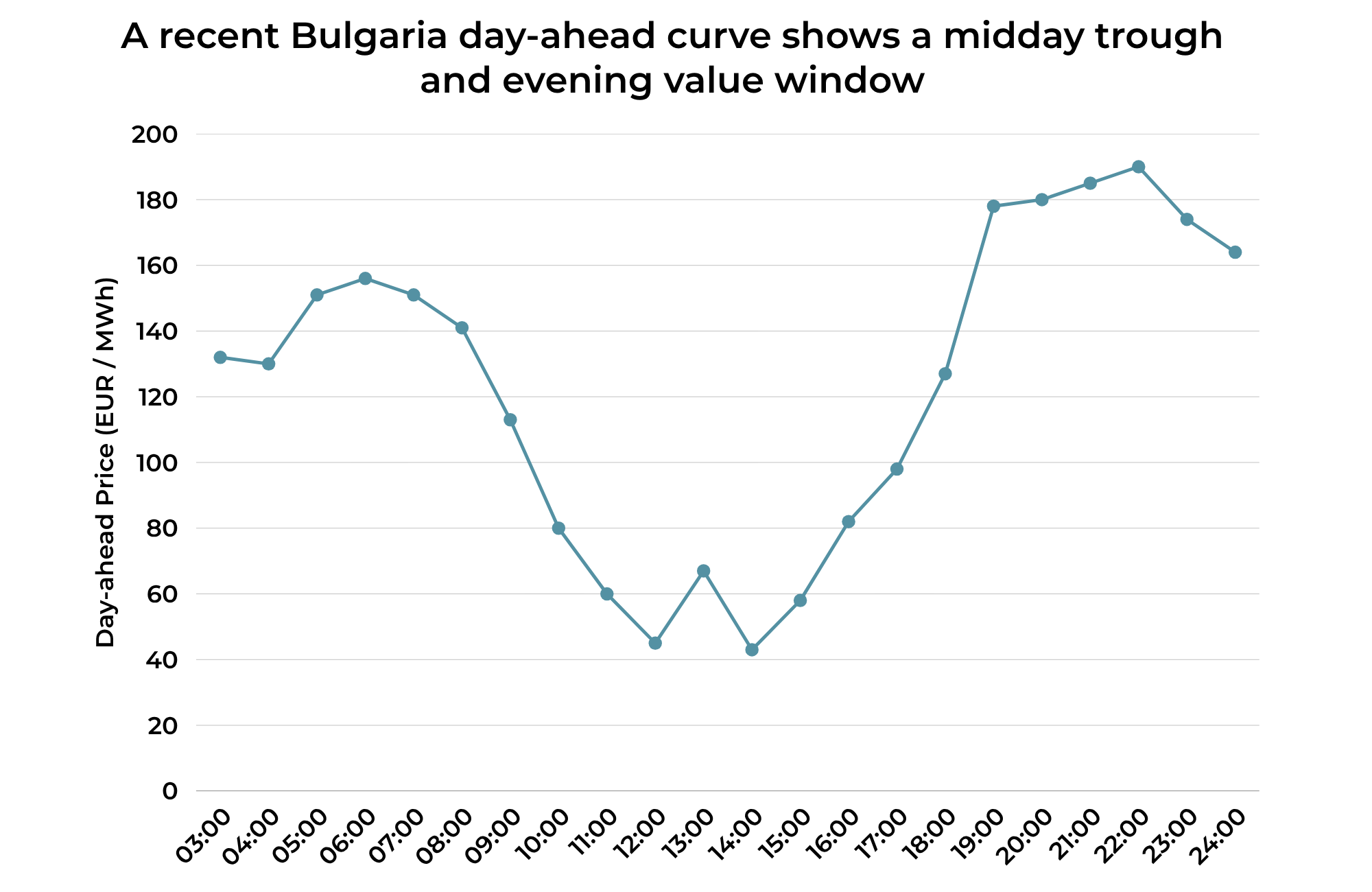
That growth is now reshaping the Bulgaria BESS market. Solar-heavy hours are pushing midday prices lower, while evening periods continue to create higher-value dispatch windows. Bulgaria is developing the same price shape seen in more mature solar markets, but on a faster timeline.
Bulgaria Electricity Market Structure
The structure of the Bulgaria BESS market is defined by IBEX, ESO and increasing participation across wholesale and balancing markets. Bulgaria operates as a single bidding zone. Electricity System Operator EAD manages the transmission system and balancing market, while wholesale electricity trading runs through IBEX, the Independent Bulgarian Energy Exchange. IBEX operates Day-Ahead, Intraday, and bilateral contract markets.
IBEX is part of European market coupling structures, and Bulgaria’s Intraday market is connected through the Single Intraday Coupling framework. ESO has also joined PICASSO, the European platform for aFRR balancing energy exchange. Bulgaria and Greece have been exchanging balancing energy on PICASSO since March 2025, when Greece’s TSO (IPTO) connected to the platform. Romania’s accession has been repeatedly delayed and is now projected for April 2027 per ENTSO-E’s latest roadmap; the rest of the Western Balkans (Serbia, North Macedonia, Kosovo) are not pursuing PICASSO membership at all, so cross-border integration for Bulgaria will remain centered on the Greek link for the foreseeable future.
For BESS owners, this means Bulgaria should not be viewed only as a simple wholesale-only arbitrage market. Future value will increasingly depend on the ability to move between Day-Ahead, Intraday, imbalance management, and balancing market as market rules and liquidity shift, rather than in any one of them alone. This is exactly where Capalo AI comes in: optimizing BESS assets in Bulgaria by continuously reallocating capacity across all of these markets in real time, capturing whichever layer is paying the most at any given hour rather than leaving an asset locked into a single strategy.
The Duck Curve Is Arriving
The most important market signal in Bulgaria is the changing intraday price shape. As solar generation increases, midday hours can become oversupplied. Recent Day-Ahead price data shows a clear midday trough followed by a higher-value evening window. This is the structural case for storage: batteries can absorb low-value solar generation and discharge when the system needs flexibility.
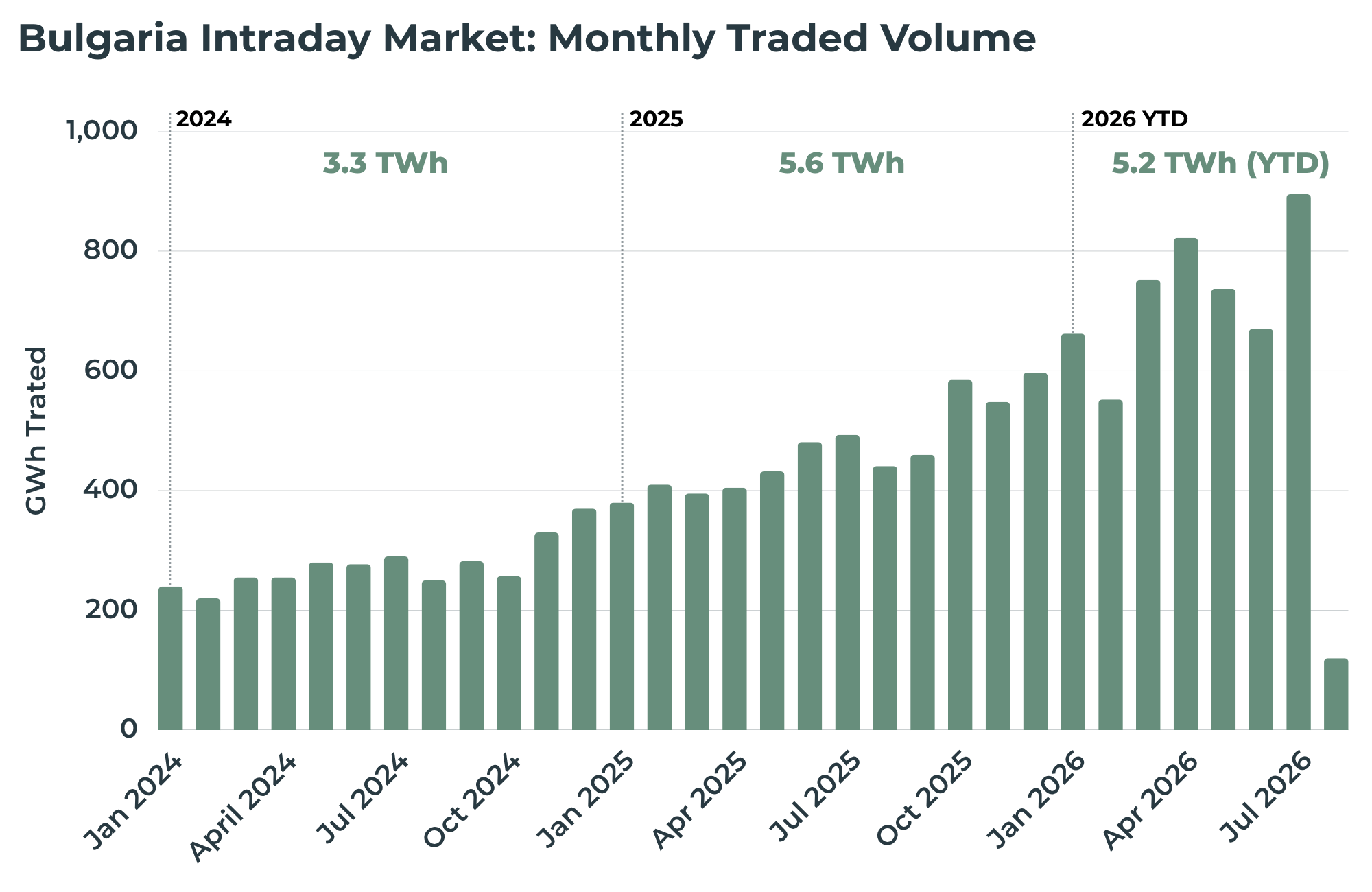
Bulgaria’s wholesale liquidity is concentrated in the Day-Ahead and Continuous Intraday Market (XBID). Over the past two and a half years, Intraday liquidity has grown steadily, with traded volume rising from 3.32 TWh in 2024 to 5.60 TWh in 2025, an increase of 68.6%. Based on volumes through early August, 2026 is on pace for roughly 8.8 TWh, a further 58% increase. Average hourly traded volume has nearly tripled, from 378 MW in 2024 to 641 MW in 2025 and 1,007 MW in 2026. Balanced buy and sell volumes indicate a maturing two-sided market. For BESS owners, this sustained depth supports larger Intraday positions without materially moving prices.
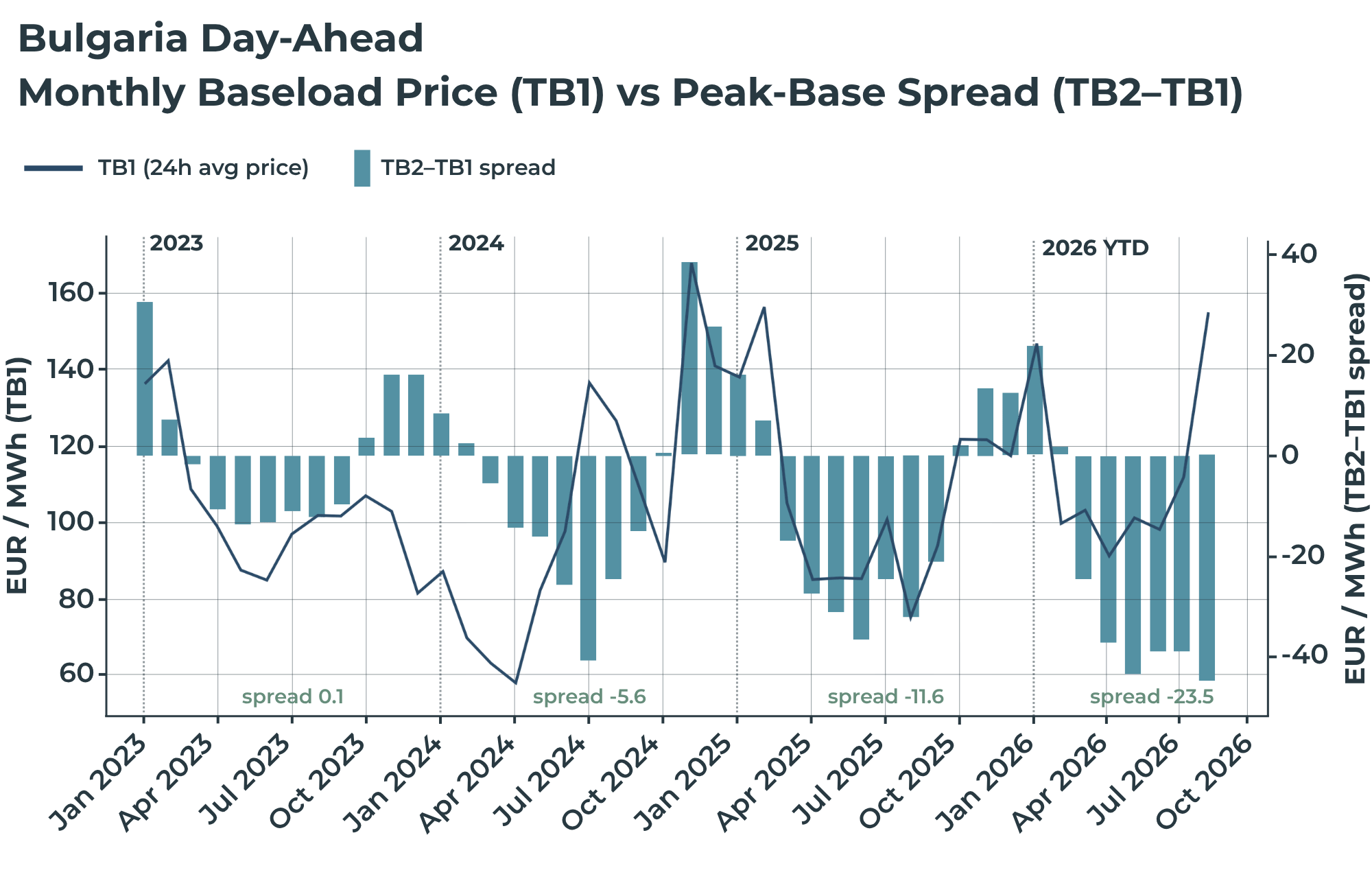
Monthly Day-Ahead prices also indicate a seasonal and increasingly volatile market. Baseload prices (the 24-hour average) have remained roughly in the range of €103–109/MWh from 2023 to mid-2026, but the daily price shape has shifted. Average midday/peak price (08:00 to 20:00) was broadly level with the 24-hour average in 2023, then fell by €5.56/MWh in 2024, by €11.63/MWh in 2025, and by €23.45/MWh through July 2026. Negative-price hours rose from 11 in 2023 to 55 in 2024 and 170 in 2025, with 166 already recorded in just over seven months of 2026. This widening daytime discount strengthens the arbitrage case for responsive storage.
Persistent Day-Ahead spreads reinforce the same conclusion. The average daily spread between the highest and lowest hourly price was €126/MWh in 2023, €183/MWh in 2024, €165/MWh in 2025, and €149/MWh in 2026 to date. Within 2026, it ranged from €100/MWh in February to €176/MWh in May, a 76% swing. Although spreads typically compress as more storage enters the market, Bulgaria still shows some of the widest in the region, highlighting the current commercial opportunity for BESS.
What Makes the Bulgaria BESS Market Attractive for BESS Owners?
The duck curve gives Bulgaria a strong starting case for storage: a widening gap between low midday prices and higher evening prices creates a clear arbitrage signal. But capturing that signal from Day-Ahead alone leaves value on the table.
Running all three markets well at once is a different task than running one. It means deciding in near real time which market is paying the most for a given hour, executing across systems with different gate closure times and bidding formats, and doing so without compromising battery health or breaching commercial agreements. This is where the choice of trading partner matters as much as the choice of hardware.
An asset owner evaluating BESS economics in Bulgaria should look past headline duck curve numbers and ask whether a given trading approach can actually operate across Day-Ahead, Intraday, and balancing as each market matures, not just the one that is easiest to access today.
Outlook for Bulgaria’s BESS Market
The Bulgaria BESS market has the ingredients for long-term growth: fast solar growth, rising price volatility, direct storage support, and a system that badly needs more flexibility. The growth is already showing up in the numbers. KEVR reports 4,011 MW / 12,240 MWh installed as of June 2026, and expects that to pass 6,000 MW / 18,000 MWh by year-end, roughly 50% growth in six months. That pace is exactly why saturation risk is worth taking seriously. More batteries flatten the price spreads and balancing opportunities they’re all chasing, so an asset’s return will increasingly come down to how well it’s operated, not when it was commissioned.
But the next phase will reward better operators, not only early movers.
The Bulgaria BESS market is entering a new phase where optimization quality will increasingly determine commercial performance. In a maturing market, single-market strategies become fragile. Multi-market optimization is what allows storage assets to keep adapting.
Capalo AI in Bulgaria
Capalo AI is already trading in Bulgaria. Capalo AI provides optimization and trading services for the asset, including Day-Ahead and Intraday market participation, BRP services, and coordinated dispatch of solar and storage as one flexible unit.
Whether you’re developing a new project or operating an existing asset, get in touch to learn how Capalo AI can maximize your asset’s value through intelligent optimization and trading.
